


HOW WE SELECT MATERIALS
Performance, Safety and Sustainability
Every material decision starts with a single question: Will it perform? A material that can’t deliver the acoustic results our customers need doesn’t make it past the first filter, regardless of its environmental credentials. Performance is non-negotiable.
The deeper point is that this rarely forces a trade-off. The materials that perform best in acoustic treatment — inorganic, fibrous mineral wool of appropriate density — have some of the most extensively documented research records of any building material and are produced by manufacturers operating under independently audited environmental management systems. That overlap isn’t a coincidence; it’s why these materials became the industry standard in the first place.

What Is Mineral Wool?
Mineral wool is the umbrella term for a family of porous, fibrous absorptive materials made from inorganic minerals. The two main branches are rock mineral wool — made primarily from basalt rock and recycled steel slag — and glass mineral wool (sometimes called fiberglass or rigid fiberglass), made from sand and recycled glass. A note on terminology: “Rockwool” is frequently used as a generic term, but it’s actually a brand name. Rockwool is a specific manufacturer, not a material category.
All mineral wool products work on the same physical principle: sound energy enters the fiber structure, travels through it, and converts to heat through friction. They are not foam. Foam absorbs through a different mechanism and with different performance characteristics. When GIK refers to mineral wool, we mean a family of proven, inorganic absorptive materials that have been the foundation of serious acoustic treatment for decades — and that have one of the most extensively documented occupational health research records in building materials, including the IARC 2002 monograph and the EUCEB bio-solubility framework.

Density and Gas Flow Resistance
Thickness alone doesn’t determine how a panel performs. A thicker panel reaches deeper into the bass spectrum — that part is straightforward. What’s less obvious is that thickness only matters if the material also allows sound to actually move through it.
The property that governs this is called gas flow resistance. Pack the fibers too densely and sound reflects off the surface rather than entering the material. Add more thickness to an overly dense material and you get a thicker wall, not a deeper absorber — performance can actually get worse. The counterintuitive result is that denser is not always better.
This is why GIK engineers the density of the mineral wool differently across products. A dedicated bass trap designed to reach 50 Hz needs different gas flow resistance characteristics than a broadband panel targeting early reflections. Getting that match right is what separates well-designed acoustic treatment from products that are simply packaging insulation in a fabric-covered frame.
The Specific Materials We Use
GIK operates manufacturing facilities in the United States, the United Kingdom, and Poland. In each location, we source the best available mineral wool locally, ensuring acoustic and safety performance is consistent across markets, even though the specific products differ. Shipping materials across continents adds carbon and supply-chain complexity without improving acoustic performance. Local sourcing means lower transport emissions, stronger regional supply chains, and products that meet the specific environmental and safety standards of each market where they are manufactured and sold.

US – Knauf ECOSE
Knauf Earthwool is a glass mineral wool product. According to Knauf’s published product documentation, Earthwool uses ECOSE Technology, which it describes as a bio-based binder made without using formaldehyde, phenols, or acrylics and as 70% less energy-intensive to produce than traditional binders. Knauf states that Earthwool is manufactured with 55% recycled glass content. Knauf’s GREENGUARD Gold certification relies on independent third-party testing to verify that Earthwool meets emissions thresholds, including for formaldehyde.
Knauf also states that Earthwool’s ECOSE bio-based binder is designed to reduce embodied energy compared to traditional phenol formaldehyde binders. GIK directs readers to Knauf’s published documentation for specific figures regarding embodied energy.
• GREENGUARD Gold
• Class A / ASTM E84
• No added formaldehyde in binder (bio-based)
• UL-validated: 55% recycled glass

UK – Knauf ECOSE
Knauf Rocksilk RS45 is a rock mineral wool slab. According to Knauf’s published product documentation, RS45 is also manufactured using ECOSE Technology. The product carries a Euroclass A1 reaction to fire classification under BS EN 13501-1, the highest non-combustibility rating in the European system. These emissions claims are independently corroborated by the Eurofins Indoor Air Comfort Gold certification, which is based on independent third-party verification of VOC emissions including formaldehyde.
Knauf also states that ECOSE’s bio-based binder requires less energy to manufacture than traditional phenol formaldehyde binders. For specific figures, GIK directs readers to Knauf’s Environmental Product Declaration for the RS45, which is independently verified to EN 15804 under the International EPD System.
• LEED / BREEAM eligible
• Euroclass A1 / EN 13501-1
• Eurofins Indoor Air Comfort Gold
• EUCEB

EU – Isover Polterm Max
GIK’s Poland facility uses Isover Polterm Max, a stone mineral wool slab manufactured at Saint-Gobain’s Gliwice facility in Poland. According to Isover’s published technical documentation, Polterm Max incorporates recycled steel slag — an industrial byproduct that would otherwise go to landfill — and carries an A1 fire classification through the EN 13162 standard reference, the highest non-combustibility rating in the European system.
These claims are independently corroborated through two certifications: the CE Declaration of Performance, which requires third-party surveillance of production against EN 13162, and EUCEB certification — the European Certification Board for Mineral Wool Products — which independently verifies that the fibers are bio-soluble and not classified as carcinogenic under EU Regulation 1272/2008.
• A1 fire classification / EN 13162
• Recycled steel slag content
WHAT DECADES OF RESEARCH TELL US
Is Mineral Wool Safe?
Mineral wool has been studied for decades. The clearest answer comes from the World Health Organization’s research arm, the IARC, which in 2002 reclassified it from Group 2B to Group 3 (‘not classifiable as to its carcinogenicity to humans’). That decision was based on long-term studies of factory workers exposed to far more material than anyone living in a room with acoustic panels.
What the science says — IARC classification
In 2002, the International Agency for Research on Cancer (IARC) reclassified both insulation glass wool and rock/stone wool from Group 2B (possibly carcinogenic) to Group 3: not classifiable as to its carcinogenicity to humans. The reclassification followed large cohort studies of factory workers with career-long exposure, which found no elevated rates of lung cancer or mesothelioma. The IARC is an independent scientific body — this is not a manufacturer claim, and it is not a claim GIK is making on its own behalf.

The Asbestos Question
The comparison to asbestos comes up often enough that it’s worth addressing directly. The reason asbestos is dangerous is biopersistence: asbestos fibers lodge in lung tissue and stay there indefinitely, accumulating over a lifetime of exposure. That indefinite accumulation is what drives the disease burden.
Modern mineral wool behaves differently at the biological level. According to the biopersistence testing protocol underlying EUCEB certification (and reflected in the IARC’s 2002 reclassification), modern mineral wool fibers have a weighted half-life of less than 40 days under the relevant test method. That difference in biopersistence is precisely why the IARC reached different conclusions about mineral wool and asbestos, and why the decades of cohort studies on mineral wool workers haven’t found the kinds of outcomes associated with asbestos exposure. These are fundamentally different materials.
Handling
The most commonly cited concern about mineral wool is that cutting or handling raw, unfinished material causes temporary mechanical irritation to skin, eyes, and airways. Gloves, eye protection, and a dust mask are appropriate when working with raw mineral wool. The manufacturer Safety Data Sheets describe this as mechanical irritation, not a chemical reaction.
In a finished panel, the material is enclosed in a fabric wrap. The handling caution applies to working with the raw material, not to living with a built panel. If a panel is damaged, the same handling guidance applies as for raw material; intact panels can be handled normally.

No Off-Gassing Concern
Traditional fiberglass products used phenol formaldehyde as a binder, which created legitimate off-gassing concerns. According to Knauf, ECOSE replaces phenol formaldehyde with a plant-based binder with no added formaldehyde, phenols, or acrylics, with emissions verified under GREENGUARD Gold (US) and Eurofins Indoor Air Comfort Gold (UK). Both certifications are based on independent third-party emissions testing rather than just self-declaration.
These certifications meet emissions thresholds typically required for schools and healthcare environments. The certification covers emissions performance against a defined standard; it is not a finding of medical suitability for any individual user.
Recycled Content, Green Building Ratings, and Fire Classifications
Environmental Credentials
Environmental credentials in building materials are a field full of unverified marketing language. Our approach is to present what is independently documented and to be specific about what comes from manufacturer specifications versus what has been verified by a third party.
Knauf Earthwool
According to Knauf’s published product information, Performance+ Earthwool with ECOSE is manufactured with up to 55% recycled glass content — material that would otherwise require virgin sand and energy-intensive processing. Knauf also states that ECOSE’s bio-based binder is designed to reduce embodied energy compared to traditional binders, and that ECOSE can contribute toward LEED and other green building ratings. These are manufacturer-stated figures; GIK directs specification teams to Knauf’s lifecycle documentation for the underlying data and can facilitate access to that documentation for projects requiring it.
Knauf Rocksilk RS45 with ECOSE
According to Knauf’s published product documentation, Rocksilk RS45 is manufactured using ECOSE Technology — a plant-based binder with no added formaldehyde, phenols, acrylics, or artificial colors, with emissions verified under Eurofins Indoor Air Comfort Gold certification. Knauf states the ECOSE binder requires 70% less energy to manufacture than traditional binders, and that RS45 can contribute toward BREEAM, LEED, and WELL green building ratings through its EPD documentation and Eurofins Indoor Air Comfort Gold certification. GIK directs specification teams to the RS45 Environmental Product Declaration (S-P-02700, verified to EN 15804) for the underlying data and can facilitate access to that documentation for projects requiring it.
Isover Polterm Max
According to Isover’s published specifications, Polterm Max incorporates recycled steel slag — a byproduct of steel production that would otherwise go to landfill. It carries an A1 fire classification under EN 13162, independently certified under European standards.
Certifications at a Glance

GREENGUARD Gold
Applies to: Knauf ECOSE (US/UK) / Isover Polterm Max (EU)
Independent third-party verification of VOC emissions; meets the standard for schools and healthcare environments. Issued by UL Environment — not Knauf, not Isover, not GIK.

Class A / ASTM E84
Applies to: US & UK products
Highest North American fire performance rating for surface-burning characteristics.
A1/ EN 13162
Applies to: EU products
European Class A equivalent; non-combustible mineral wool classification.

ISO 14001
Applies to: Camira Cara fabrics
Environmental management system certification; independently audited on an ongoing basis.

OEKO-TEX 100
Applies to: Camira Cara fabrics
Independently tested and verified for emissions of certain harmful substances; safe for prolonged skin contact.

Indoor Advantage Gold
Applies to: Camira Cara fabrics
Indoor air quality verification for contract fabrics.
LEED / BREEAM
Applies to: Knauf ECOSE
Knauf states ECOSE’s bio-based binder and recycled content contribute toward green building points. GIK can provide supplier documentation for specification projects on request.
What Else Is in a GIK Panel?
Frames, Adhesives, and Acoustic Fabric
The mineral wool is the core of the panel, but it’s not the whole story. GIK uses regionally sourced plywood for frames across all three facilities, and all adhesives used in construction have no added formaldehyde according to supplier specifications — consistent with the same standard we apply to everything else.
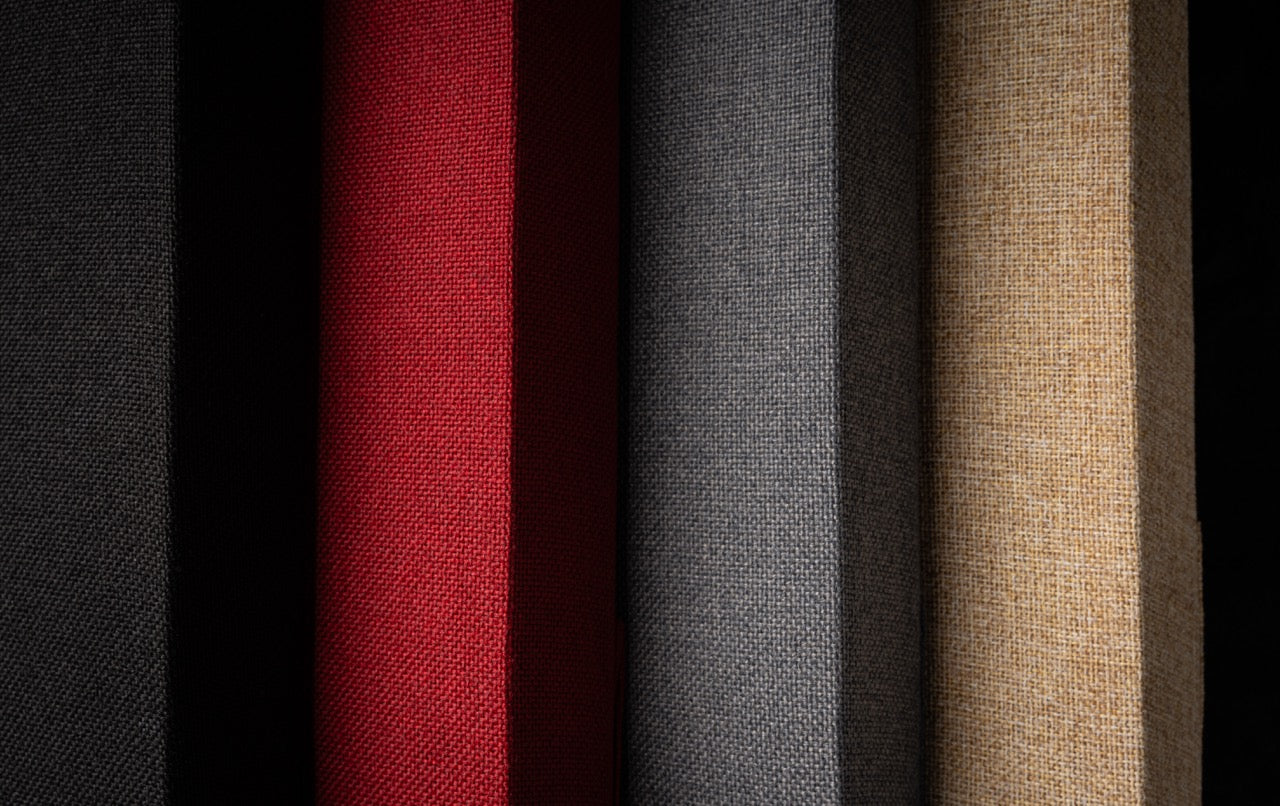
Every GIK panel worldwide ships finished in Camira Cara, a purpose-woven acoustic fabric designed to let sound energy pass through freely while contributing a small amount of additional absorption. Camira’s environmental credentials are among the strongest available in contract fabrics: ISO 14001 certified since 1996, OEKO-TEX Standard 100 certified (independently tested and verified for certain emissions of harmful substances), and Indoor Advantage Gold certified for indoor air quality. Camira has published independently verified Environmental Product Declarations for 21 fabrics across their full lifecycle, and is a signatory of the UN Global Compact. Rather than summarizing Camira’s EPD figures ourselves, we link directly to their published documentation, which carries the full verification methodology.

Are GIK Acoustic Panels Safe?
The same mineral wool that goes into our panels is used in walls, ceilings, and HVAC systems in homes, schools, and hospitals around the world. It carries independent third-party certifications for emissions and for fibre bio-solubility, and the IARC’s 2002 Group 3 classification reflects the current scientific consensus on long-term exposure. UL Environment, Eurofins, EUCEB, and the IARC are the authoritative sources on those claims.
What GIK adds is the acoustic engineering — optimizing material density to application, building panels that perform consistently over years without degrading or sagging, and being honest about what we know, what we’ve verified independently, and what we’re taking on trust from our suppliers.
Performance first. Then safety. Then sustainability. With independently certified materials, those priorities reinforce rather than compete with one another
A note on how we source and present material claims
GIK manufactures acoustic panels. We do not manufacture the raw materials inside them. Throughout this article, we distinguish between three types of claims: third-party certifications (independently verified by a named certifying body, linked to that body’s database), manufacturer specifications (figures published by our material suppliers, attributed explicitly and linked to their data sheets), and directional claims (general statements about design intent where precise figures are not independently verified). GIK has not independently verified all manufacturer-stated figures referenced in this article; where we cite such figures, they are attributed to their source. We request written supplier confirmations of key claims periodically and can provide materials documentation in support of specific claims for specification projects on request.
FAQs
Are GIK Acousticpanels safe to breathe around once installed?
The mineral wool inside a GIK panel sits inside a Camira Cara fabric wrap, so it isn’t exposed to the air in your room. On long-term exposure: the IARC classifies modern mineral wool as Group 3 (‘not classifiable as to its carcinogenicity to humans’) based on studies of factory workers, not residential users. EUCEB-certified bio-soluble fibers also clear from the lung quickly. If you have specific medical concerns, the manufacturer Safety Data Sheet is the right document to bring to your doctor.
Do GIK Acoustic panels off-gas or emit VOCs?
The Knauf ECOSE materials used in our US and UK products are independently tested for VOC emissions: GREENGUARD Gold certification in the US, Eurofins Indoor Air Comfort Gold in the UK. Both require ongoing third-party testing, not a one-off declaration from the manufacturer. According to Knauf, the ECOSE binder contains no added formaldehyde, phenols, or acrylics, and we use formaldehyde-free adhesives, according to supplier specifications, in panel construction.
What is mineral wool, and how is it different from asbestos?
Mineral wool is a family of inorganic fibrous materials made from basalt rock, recycled slag, sand, or recycled glass. It is not asbestos and does not behave like asbestos. The fundamental difference is biopersistence: asbestos fibers accumulate in lung tissue indefinitely; modern mineral wool fibers have a weighted half-life of less than 40 days under the relevant test method, per the EUCEB biopersistence framework. This difference is why the IARC reclassified mineral wool to Group 3 (‘not classifiable as to its carcinogenicity to humans’) in 2002, while asbestos remains a Group 1 known carcinogen. Group 3 reflects inadequate evidence for classification rather than a positive finding of safety, but the practical implication is that the asbestos-comparable risk profile that drove the original Group 2B classification was not borne out in long-term worker studies.
Are GIK materials certified to the standards used in schools and healthcare environments?
Knauf Earthwool, the mineral wool used in our US-manufactured panels, carries GREENGUARD Gold certification — the standard applied specifically to products used in schools and healthcare environments, where indoor air quality requirements are more stringent than standard residential settings. GREENGUARD Gold is issued by UL Environment through independent third-party testing, not declared by Knauf or by us. The full certification record is in UL’s public database.
Are GIK panels safe for people with chemical sensitivities or allergies?
If you have specific chemical sensitivities or allergies, start with the manufacturer Safety Data Sheets for the materials in your panel (we can send these on request) and review them with your healthcare provider. For context: Knauf states that ECOSE-bound materials contain no added formaldehyde, phenols, acrylics, or artificial colorants. GREENGUARD Gold (US) and Eurofins Indoor Air Comfort Gold (UK) independently verify VOC emissions, and the Camira Cara fabric is OEKO-TEX Standard 100 certified, meaning it has passed independent safety tests for harmful substances.
Do GIK panels contribute to LEED or BREEAM green building ratings?
Knauf states in its published product documentation that ECOSE’s bio-based binder and recycled content can contribute toward LEED and BREEAM certification points. GIK doesn’t independently verify green building point calculations, which depend on the specific project, certification path, and reviewer. We can provide Knauf’s materials documentation to specification teams on request. Contact a GIK Designer for project-specific support.
What is the Greensafe initiative?
Greensafe is GIK’s materials philosophy, launched in 2012: a commitment to acoustic products built from materials that meet the highest available standards for safety, environmental responsibility, and sourcing transparency. It covers every component of a GIK panel — the mineral wool, the binder, the frame, the adhesives, and the fabric. Greensafe is not a third-party certification. It is our own standard for what goes into every product, and our commitment to being open about what we’ve independently verified and what we’re taking on our suppliers’ word.
